Reflections on Harrisburg, Pennsylvania real estate, life, motorcycling, travel, politics, land, building, food and anything else that strikes my fancy
Showing posts with label housing crisis recovery. Show all posts
It's a long way back from the days when looking at credit worthiness was only lip service. Today's market is good but based on realistic expectations of borrowers paying back their mortgages. No requirement for perfect credit = the majority of closed loans have credit scores between 600 and 750.
To see what tis means in your unique situation, call, text or email
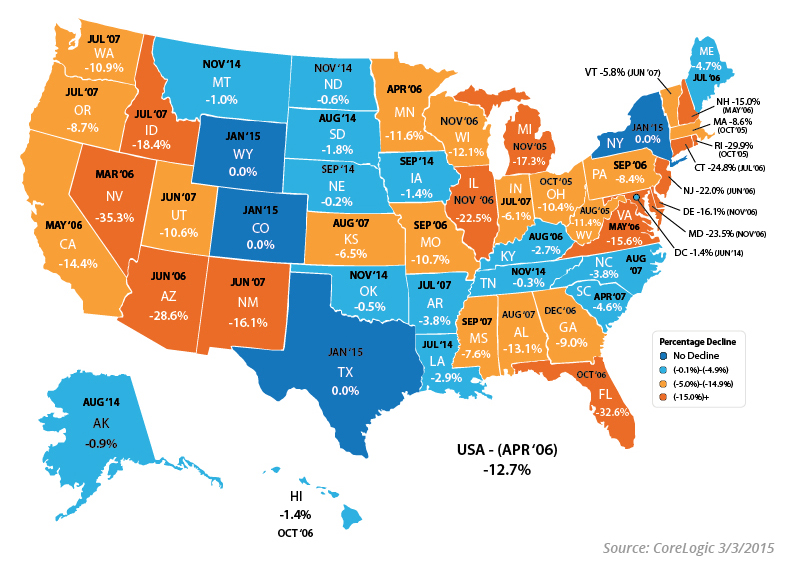
Map showing when the peak house price was reached and where we are now. For instance, Montana peaked in August of 2007 and is currently still 2.1% below the peak.
Here, in Pennsylvania, prices peaked in September of 2006 and we are still 4.8% down from there statewide.
To see how this applies to your unique situation, call text or email
When you are ready to move, new home or existing home just call text or email.
Feb. new-home sales soar to 7-year high
Doug Carroll, USA TODAY 4:24 p.m. EDT March 24, 2015
New-home sales soared almost 8% in February as a snowy winter month failed to deter buyers as expected.
Sales of single-family homes rose to a seasonally adjusted annual rate of 539,000, up 7.8% from January, the Commerce Department said Tuesday. That dwarfed economists' median forecast for a 470,000 annual rate and a small monthly decline, according to Action Economics' survey before the report.
Instead, January's sales rate also was revised up to 500,000 from 481,000 previously reported.
February's rate was the highest since February 2008. The last time new-home sales had back-to-back months with rates at or topping 500,000 was in April-May 2008, according to Census Bureau data from Haver Analytics.
Preliminary figures released Tuesday show February sales rates compared with January's surged 152% in the Northeast, fell 13% in the Midwest, rose 10% in the South and fell 6% in the West. The South and West account for the bulk of the national total.
Economists caution that the monthly new-home sales data are volatile because the sample sizes are small and the seasonal adjustments can produce unreliable data. Last month's figures could be revised down in next month's report as more data come in.
Not adjusting the data for seasonal variations shows new-home sales for the past 12 months total 450,000 through February. That is the highest 12-month figure since January 2009, but the trend is still about the same total as the month before, says Richard Moody, chief economist of Regions Financial.
"Yes, the pace of sales is improving, but that improvement continues to come at a grudging pace," he said in a note to clients. "While we do expect the pace to increase steadily over the course of 2015, we nonetheless expect that increase to remain gradual."
The median price of homes sold last month was $275,000. On a seasonally adjusted basis, the supply of new homes for sale fell 1.6% from January but rose almost 13% from a year earlier.
Builders are modestly optimistic about their industry's prospects this year, citing shortages of lots and labor and tight loan underwriting standards as factors that continue to strain supply.
The National Association of Home Builders/Wells Fargo confidence index for March dropped two points to 53, the NAHB said on March 16. It was the third straight monthly decline. The index is seasonally adjusted.
Index readings above 50 indicate more builders view market conditions as good rather than poor.
Existing-home sales also have been modest. The National Association of Realtors reported Monday that February sales rose 1.2% to a seasonally adjusted annual rate of 4.88 million. That was a little short of economists' consensus forecast and below the average monthly rate of 4.92 million last year and 5.07 million in 2013.
Many forecasts call for improved home sales this year.
In buyers' favor, interest rates remain near historic lows. The average U.S. fixed rate on a 30-year mortgage has mostly hovered below 4% since October and was 3.78% last week, according to mortgage financier Freddie Mac. But recent reports say lenders are restricting loan approvals for applicants with less than superior creditworthiness
Thursday, March 12, 2015
Is Another Bubble Forming?
March 12 2015
After the housing market bust we experienced across the country in 2008, many experts have been quick to warn that a new bubble may be forming in some areas.
One particular example of this is a recent article pointing toward the California Bay Area’s price gains over the last 18 months.
The quickest and easiest way to show how far we’ve come and how far we still need to go in regards to the ‘Peak’ is to share CoreLogic’s Price & Time Since Peak figures, used to create the map below.
Even with the high performance of prices in the Bay Area, the state of California as a whole is still -14.4% below their Peak, experienced in May of 2006.
Note that Pennsylvania as a whole is still 8.4% below the 2006 peak.
The biggest challenge facing the housing market’s recovery right now is the lack of inventory available for sale. Prices are determined by supply and demand. Right now buyer demand is out-pacing seller supply, across many price ranges, driving prices up.
Bottom Line
Traditionally the Spring months have been the most popular dates sellers choose to list their homes. With additional inventory coming to market soon, meet with a professional in your local market to evaluate your best course of action.
When you are ready to see how this applies to your unique situation just call, text or email me.
Is the Housing Market Back? Ask Lowes & Home Depot!
March 9 2015
A recent Bloomberg Business article reports that both Lowes & Home Depot experienced fourth quarter profits that beat revenue projections by the most in six quarters. So what does that mean to the housing market?
Consumer Confidence
Lowe’s Chief Executive Officer Robert Niblock said,
“Consumers are feeling better about their jobs, their wages and certainly feeling better about the value of their home, they are re-engaging in projects that they have put off.”
Sales to professional contractors have increased significantly as well, and were a driving factor in the quarter. Home Depot’s Chief Financial Officer Carol Tome calls this a “sign of health. If they are putting more items in their basket, it means they have work coming at them.”
Home Values Rising
In a quarterly consumer survey conducted by Lowe’s since 2007, the percentage of respondents who said that the value of their home is rising increased to its highest value ever, at 50%.
Whether Americans are finally adding that man-cave they’ve always wanted, or renovating a master suite, an increased confidence in the value of one’s home often sparks homeowners to invest in big-ticket projects.
The National Association of Realtors (NAR) reports that the median price of an existing home (for all housing types) rose year-over-year for the 35th consecutive month.
Not all who are renovating are planning on staying in their home. The Demand Institute reports that“nearly half of American households plan to move at some point in the future.”
For those who are planning on listing their home this spring, spending the time and money needed to update that 1950’s bathroom or kitchen can fetch higher prices in today’s market.
Bottom Line
Meeting with a local real estate professional can give you insight into the small (or big) improvements your home could use to draw the highest price and return on investment this spring.
The Census recently released their 2014 Homeownership Statistics, and many began to worry that Americans have taken a step back from the notion of homeownership.
Easy… Chicken Little
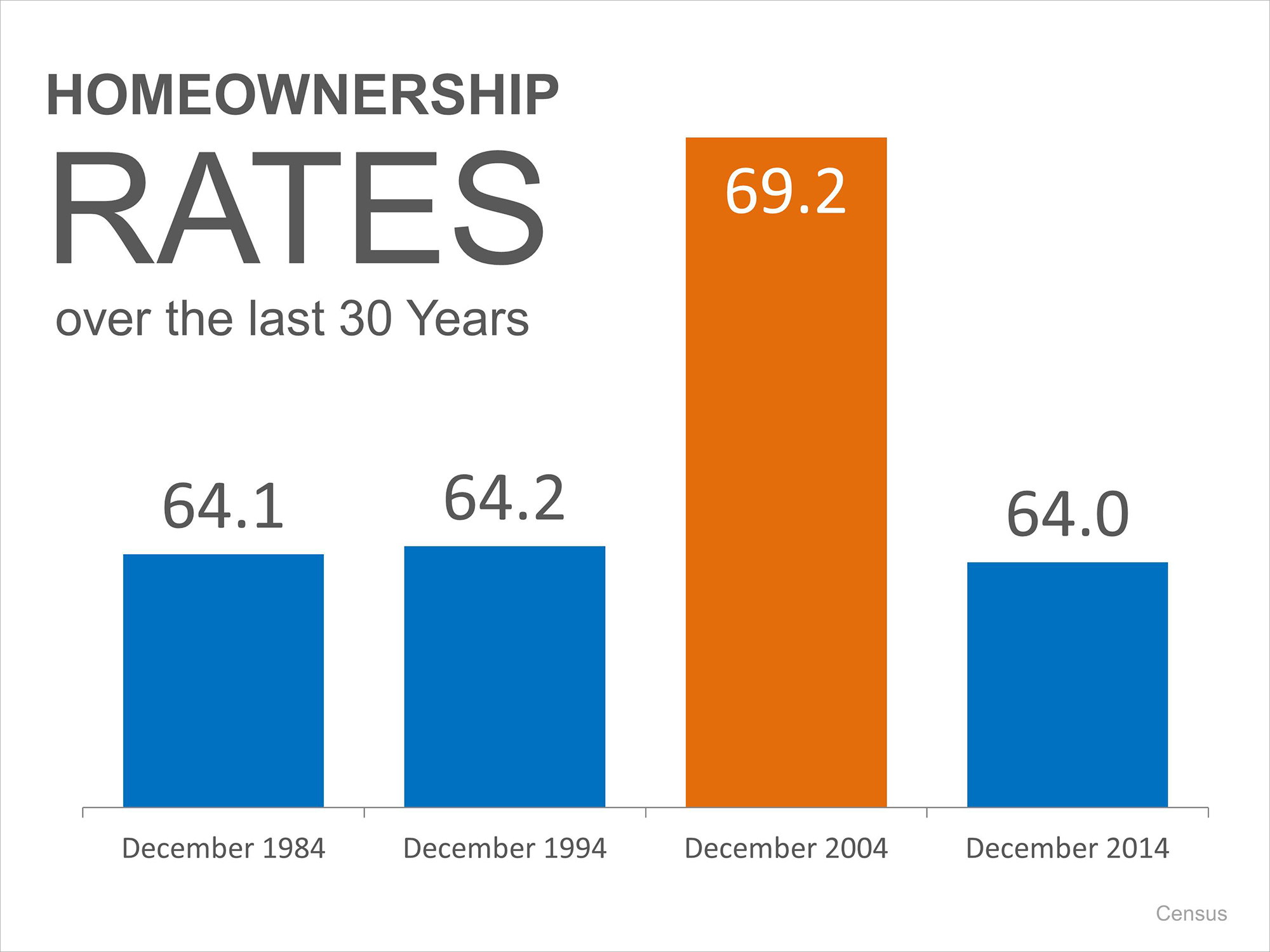
The national homeownership rate peaked in 2004, representing a 69.2% of Americans who bought vs. rented their primary residence. Many have noticed a decline in rate since then and taken that as a bad sign.
However, if you look at the national rate over the last 30 years (1984-2014), you can see that the current homeownership rate has returned closer to the historic norm. 2014 ended the year with a rate of 64% just under the rate in 1985 and 1995.
Bottom Line
With interest rates and prices still below where experts predict, evaluate your ability to purchase a home with a local real estate professional.
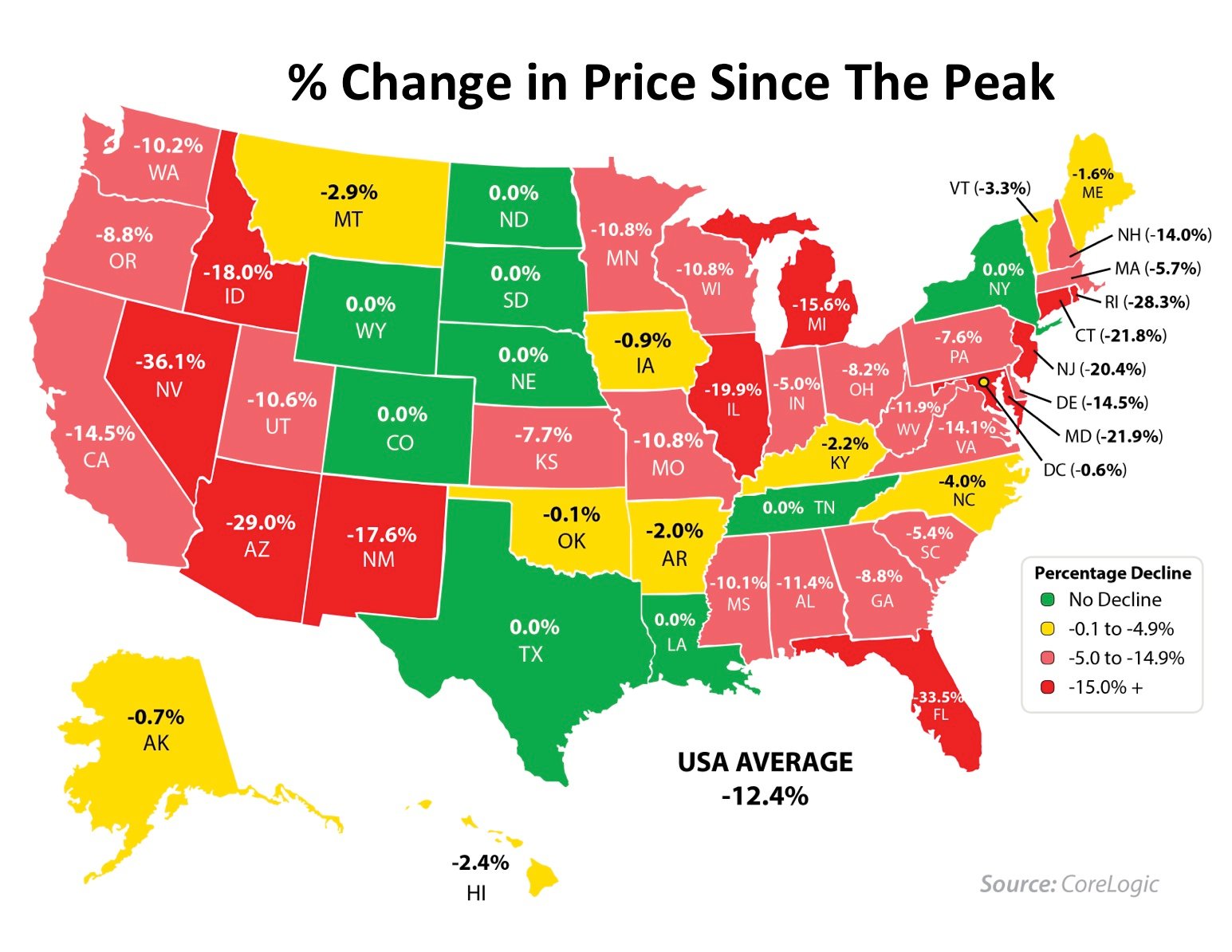
A look a where we are compared to the peak. Most areas are not back yet to what they were 7-8 years ago
Home Values Compared to the Peak of 2006-2007
December 22 2014
There is no doubt that the housing market has recovered from the meltdown that occurred just a few short years ago. However, in some states home values still have not returned to the prices we saw in 2006 and 2007. Here is a breakdown showing where current prices are in each state as compared to peak prices.
Instead of focusing on the lack of credit requirements that were forced on the mortgage industry prior to 2008. The media has chosen to ignore the facts and focus on down payments rather than creditworthiness.
After it was announced that Fannie Mae and Freddie Mac would again make available mortgage loans requiring as little as a 3% down payment, many people showed concern. Were we going back to the lower qualifying standards of a decade ago that caused the housing market crash? Won’t lower down payments dramatically increase the default rates? Will we again be faced with an avalanche of short sales and foreclosures?
The simple answer is - NO. Let’s look at the data.
While it was happening (2011)
Back in 2011, as we were just recovering from the worst of the Great Depression, many organizations were looking for the cause of the massive default rate on mortgages.
The National Association of Realtors (NAR), the Center for Responsible Lending (CRL), the Mortgage Bankers Association (MBA), the National Association of Home Builders(NAHB), the Community Banking Mortgage Project and the Mortgage Insurance Companies of America (MICA) issued a white paper on the subject titled: Proposed QRM Harms Creditworthy Borrowers and Housing Recovery.
Let's look what the report says:
“In the midst of a very fragile housing recovery, the government is throwing a devastating, unnecessary and very expensive wrench into the American dream. First time homebuyers will have to choose between higher rates today or a 9-14 year delay while they save up the necessary down payment…
High down payment and equity requirements will not have a meaningful impact on default rates. But they will require millions of consumers, who are at low risk of default, to either put off buying a home or pay unnecessarily high rates. The government is penalizing responsible consumers, making homeownership more expensive or simply out of reach for millions. We urge regulators to develop a final rule that encourages good lending and borrowing without punishing credit-worthy consumers.”
The report actually studied the impact a higher down payment would have had on the default rates of loans written from 2002 through 2008. The report states:
“…moving from a 5 percent to a 10 percent down payment on loans that already meet strong underwriting and product standards reduces the default experience by an average of only two- or three-tenths of one percent... Increasing the minimum down payment even further to 20 percent… (creates) small improvement in default performance of about eight-tenths of one percent on average.”
Today (2014)
Just last week, the Urban Instituterevealed data showing what impact substantially lower down payments would have on default rates in today’s mortgage environment. Their study revealed:
“Of loans that originated in 2011 with a down payment between 3-5 percent, only 0.4 percent of borrowers have defaulted. For loans with slightly larger down payments—between 5-10 percent—the default rate was exactly the same. The story is similar for loans made in 2012, with 0.2 percent in the 3-5 percent down-payment group defaulting, versus 0.1 percent of loans in the 5-10 percent down-payment group.”
Bottom Line
We believe that the Institute concluded their report perfectly:
“Those who have criticized low-down payment lending as excessively risky should know that if the past is a guide, only a narrow group of borrowers will receive these loans, and the overall impact on default rates is likely to be negligible. This low down payment lending was never more than 3.5 percent of the Fannie Mae book of business, and in recent years, had been even less. If executed carefully, this constitutes a small step forward in opening the credit box—one that safely, but only incrementally, expands the pool of who can qualify for a mortgage.”
There is a lot of conflicting information about the state of housing in the U. S.. One reason is that the difference in what has occurred by state.
This map shows the date of the peak prices and how much home prices are off from that peak.
The differences are HUGE. Nevada peaked in 2006 and is still off over 37%. A whole group of states including Texas, Colorado, Vermont and Alaska are now (2014) at their peaks.
Certainly there are also variations within states as well and within local markets. Here in the Harrisburg area, the difference is clear between the shores of the Susquehanna.
As always, if you have questions bout what this means regarding the home you would like to buy or sell, just call text or email.